From Gallipoli to Long Tan and Beyond
A Story of the ANZACS - One of Many Stories


ADVANCE AUSTRALIA FAIR
Australians all let us rejoice,
For we are young and free;
We've golden soil and wealth for toil,
Our home is girt by sea;
Our land abounds in Nature's gifts
Of beauty rich and rare;
In history's page, let every stage
Advance Australia fair!
In joyful strains then let us sing,
"Advance Australia fair!"
For we are young and free;
We've golden soil and wealth for toil,
Our home is girt by sea;
Our land abounds in Nature's gifts
Of beauty rich and rare;
In history's page, let every stage
Advance Australia fair!
In joyful strains then let us sing,
"Advance Australia fair!"
Beneath our radiant southern Cross,
We'll toil with hearts and hands;
To make this Commonwealth of ours
Renowned of all the lands;
For those who've come across the seas
We've boundless plains to share;
With courage let us all combine
To advance Australia fair.
In joyful strains then let us sing
"Advance Australia fair!"
We'll toil with hearts and hands;
To make this Commonwealth of ours
Renowned of all the lands;
For those who've come across the seas
We've boundless plains to share;
With courage let us all combine
To advance Australia fair.
In joyful strains then let us sing
"Advance Australia fair!"
Adelaide National War Memorial , the First National War Memorial in Australia on ANZAC DAY 2011

,,,,,,,,,,,,,,,,,,,,,,,,,,,,,,,,,,,,,,,,,,,,,,,
Australia and New Zealand and the ANZAC Tradition
Australia and New Zealand and the ANZAC Tradition
The aim of this Site is to tell as much as possible of the story of the ANZACS. But not only their story, but also the men and women of Australia and New Zealand and their allies at various times in various, vital battles and campaigns, all over the World, especially, but not exclusively 1914 (the beginning of World War I ) to 1975 (Vietnam War). There was also the Boer War, Afghanistan, Iraq, and Peace- Keeping missions, outside that time frame.
It will also tell the story of the Royal Australian Air Force (RAAF), the Royal New Zealand Air Force (RNZAF), the Royal Air Force (RAF) (which even helped defend Darwin, in the middle of its darkest hours of 64 air raids over about 18 months from February 1942, to November 1943). The UK sent 64 Supermarine Spitfires to Australia to help defend Darwin. Two RAAF Squadrons, and one RAF Squadron that had been fighting in Great Britain.
By the end of WW2, Australia had 658 Spitfires, sent through submarine infested waters. The Merchant Marines of many nations, and men and boys (as young as 14) often died terrible deaths to bring supplies to and from Britain, Canada, New Zealand, the USA, India and many other nations. The bodies of many men, women and even children, are buried in Australian soil, from the USA, Holland, Britain, and many other nations, who helped defend us from the Japanese.
The Australian Army, the New Zealand Army, The Indian Army, The Indian Navy, The US Army. The US Marine Corps, the British Army, the US Navy, The Dutch Army, Navy and Air Force, the US Army Air Force, and the citizens of Malaya, Borneo, the then Dutch East Indies, the people from Papua New Guinea, France, and even Italy (at some points), Canada and many other nations have played a vital role in our Military history, including us helping them, them helping us, and any of these organisations or countries working together for the defeat of those who sought to overwhelm and enslave a big chunk of the World.
Australian men and women died all over the World, especially in WW1 and WW2, defending our allies (including the Russian Convoys in WW2). Australia did not even have an Permanent Army till after WW2. We were defended by 4,000 regulars who trained part-time Militia (CMF) soldiers, who together with the RAN, RAAF and various Auxiliaries, kept us safe.

The Australian Army heroes of 1918 in France, such as General John Monash, and Brigadier "Pompey" Elliot, who engaged a rampaging, and huge German Army of over one million, which poured into France after the Russian surrendered, and together with the one million Germans already in France, were poised to take Paris and the Channel Ports, and win WWI, were CMF officers, before WWI. John Monash landed at Gallipoli, as a Colonel.

In 1918, in charge of 100,000 Australian Soldiers, he took on 39 German Divisions, in around 5 months, and defeated all of them (around 1,000,000 German soldiers, including the elite Prussian Guard), helped by their Allies (mainly British and American) in punching holes in the Hindenburg Line. and had the Germans pouring back into their own country in hordes. An amazing victory, by an amazing man, the son of a German Jew, who fled persecution, to Australia.
John Monash was an architect, engineer, and lawyer, and Rhodes Scholar. and a very skilled soldier. He returned to Australia, and gave as much help as he could to the badly damaged soldiers who returned home, to face many problems.
The Australian Army heroes of 1918 in France, such as General John Monash, and Brigadier "Pompey" Elliot, who engaged a rampaging, and huge German Army of over one million, which poured into France after the Russian surrendered, and together with the one million Germans already in France, were poised to take Paris and the Channel Ports, and win WWI, were CMF officers, before WWI. John Monash landed at Gallipoli, as a Colonel.
In 1918, in charge of 100,000 Australian Soldiers, he took on 39 German Divisions, in around 5 months, and defeated all of them (around 1,000,000 German soldiers, including the elite Prussian Guard), helped by their Allies (mainly British and American) in punching holes in the Hindenburg Line. and had the Germans pouring back into their own country in hordes. An amazing victory, by an amazing man, the son of a German Jew, who fled persecution, to Australia.
John Monash was an architect, engineer, and lawyer, and Rhodes Scholar. and a very skilled soldier. He returned to Australia, and gave as much help as he could to the badly damaged soldiers who returned home, to face many problems.
Few Australians probably knew how vulnerable we were in both World War I and World War II.
It is often claimed by critics that we sent men and women (many nurses served and died in WWI and WWII and other conflicts) merely as cannon fodder for the British Empire. However, Australia's future, as a nation, depended on the fate of Britain and its Empire, for had Britain fallen in either World War, our fate as a Nation, would more than likely have been disastrous.
Kaiser Wilhelm of Germany wanted France, Italy, Russia and the rest of Europe, so he'd have a bigger Empire than his cousin, King George, V in WWI. Adolf Hitler wanted to rule Europe and much of the rest of the World, and Japan wanted a big chunk too, in World War II. Australia punched above its weight in helping Britain, France, the USA and other allies, defeat both selfish plans.
Remember the Free French forces helped fight for freedom in WW2, after France fell, even in the Pacific area.
We owe a lot to all who fought for the freedom of countless millions. And we must never forget the wonderful women, who also, laid down their lives for our freedom, the nurses (many of whom died terrible deaths), and those who risked and even lost their lives behind enemies.
And back in Australia, in both World Wars, men, women and even children raised money to help the soldiers, sailors and airmen with food parcels, comforts, and to buy the planes and tanks and ships we needed.
During both major wars the men and boys of the Merchant Marine suffered terrible deaths and injuries in bring us oil, weapons, and other supplies, and take food back to feed our troops and those of our Allies.
In WW2, women helped build the 3,500 military aircraft built in Australia, along with the men, and did a huge amount of the dangerous work of manufacturing the shells, bombs and bullets, and armoured vehicles and other needs for defeating our relentless enemies.
Women played a vital role in food production via the Australian Women's Land Army, who helped replace the men from the farms and market gardens who went to War.
It was Team Australia.
And following WWI, WWII, The Korean War, Vietnam War, there have been civilian groups too numerous to mention, who have helped those warriors damaged by war to try and move on.
Many of these stories, will follow.
"LEST WE FORGET"
It is often claimed by critics that we sent men and women (many nurses served and died in WWI and WWII and other conflicts) merely as cannon fodder for the British Empire. However, Australia's future, as a nation, depended on the fate of Britain and its Empire, for had Britain fallen in either World War, our fate as a Nation, would more than likely have been disastrous.
Kaiser Wilhelm of Germany wanted France, Italy, Russia and the rest of Europe, so he'd have a bigger Empire than his cousin, King George, V in WWI. Adolf Hitler wanted to rule Europe and much of the rest of the World, and Japan wanted a big chunk too, in World War II. Australia punched above its weight in helping Britain, France, the USA and other allies, defeat both selfish plans.
Remember the Free French forces helped fight for freedom in WW2, after France fell, even in the Pacific area.
We owe a lot to all who fought for the freedom of countless millions. And we must never forget the wonderful women, who also, laid down their lives for our freedom, the nurses (many of whom died terrible deaths), and those who risked and even lost their lives behind enemies.
And back in Australia, in both World Wars, men, women and even children raised money to help the soldiers, sailors and airmen with food parcels, comforts, and to buy the planes and tanks and ships we needed.
During both major wars the men and boys of the Merchant Marine suffered terrible deaths and injuries in bring us oil, weapons, and other supplies, and take food back to feed our troops and those of our Allies.
In WW2, women helped build the 3,500 military aircraft built in Australia, along with the men, and did a huge amount of the dangerous work of manufacturing the shells, bombs and bullets, and armoured vehicles and other needs for defeating our relentless enemies.
Women played a vital role in food production via the Australian Women's Land Army, who helped replace the men from the farms and market gardens who went to War.
It was Team Australia.
And following WWI, WWII, The Korean War, Vietnam War, there have been civilian groups too numerous to mention, who have helped those warriors damaged by war to try and move on.
Many of these stories, will follow.
"LEST WE FORGET"

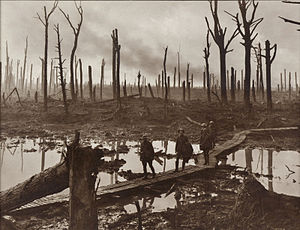

The Meaning of ANZAC
ANZAC is The Australian and New Zealand Army Corps of World War I, but the Australians and New Zealand have together bravely in several wars including WWII, Korea and Vietnam and elsewhere. Gradually stories of New Zealand Units etc will be included on this site. Information welcome.
The real meaning of ANZAC is the strong bond between Australia and New Zealand, rivals on the sporting field, and in commerce, but brothers in arms when peace is threatened by tyranny and greed or a lust for power.
.............................................
Australian Women in War
The involvement of Australian women in each war is closely connected to their role in society at different times, and the nature of each war.
Australia has been involved in a number of wars including The Boer War (1899–1902), World War I (1914–1918), World War II (1939–1945), The Korean War (1950–1953), The Vietnam War (1962–1972) and The Gulf War (1990–1991).
On the home front, women dealt with the consequences of war—managing children and family responsibilities alone, shortages of resources, as well as their fears for the future, and the grief and trauma of losing loved ones.
Many women were also actively involved as nurses and in other active service duties, and contributed more actively to war efforts through military service. Other Australian women were also closely connected with war through male relatives and friends away on military service.
In World War II, women were actively recruited into jobs that had always been the preserve of men; they worked in factories and shipyards, as members of the Women's Land Army and as Official War Artists.
Groups active at this time included the Australian Red Cross, the Country Women's Association, the Women's Christian Temperance Union, the Australian Women's National League, the Voluntary Aid Detachment, the Australian Comforts Fund and the Cheer-Up Society.
The idea that a great number of women could take up paid work in place of the men who had gone to war was resisted for a number of reasons. This resistance lasted into World War II, even though 'women beat a path to the doors of the authorities, begging to be allowed to assist, to help win the war, to give of their talents'. (Adam-Smith, Patsy 1996, Australian Women At War , Penguin Books, Australia, p 5)
By 1942, the tides of war had shifted to Australia's doorstep and roles changed out of sheer necessity. Australian women entered the workforce in unprecedented numbers and were even allowed to take on 'men's work'. These were jobs for the war, not for life. Women were paid at lower rates than men and expected to 'step down' and return to home duties after the war.
Newsreels and movies of the day show women happily coming to work in the factory each day to make bomb casings, tanks or parachutes and draws similarities between the things women are used to doing (such as filing their nails) with the work they do in the factory (such as filing the inside of munitions casings). Similar recruitment programs were used to great effect in Australia.
At the end of the war, when women were expected to give up their jobs for men who returned home from overseas conflicts, this was often a difficult transition. Many women had enjoyed participating in the workforce. The 1950s saw a dramatic change in the way women's roles were defined, as females were encouraged back into the home and their traditional roles of wives and mothers reinforced and encouraged.
 Australian War Memorial.

A poster produced in 1943 encouraging women to join the Land Army. Image courtesy of the Australian War Memorial.
The Australian Women's Land Army (AWLA) was established in July 1942,
in response to labour shortages in country areas. The Women's Land Army
recruited women to work on farms where there were no men left to do the
hard labour that was traditionally assigned to men.
AWLA was not considered a military service and never included benefits such as the pensions, deferred pay and bonuses, which were available to those women who joined WRANS, AWAS and others. By 1944 the Australian Women's Land Army (AWLA) had around 3000 members
.............................................
Australian Women in War
The involvement of Australian women in each war is closely connected to their role in society at different times, and the nature of each war.
Australia has been involved in a number of wars including The Boer War (1899–1902), World War I (1914–1918), World War II (1939–1945), The Korean War (1950–1953), The Vietnam War (1962–1972) and The Gulf War (1990–1991).
On the home front, women dealt with the consequences of war—managing children and family responsibilities alone, shortages of resources, as well as their fears for the future, and the grief and trauma of losing loved ones.
Many women were also actively involved as nurses and in other active service duties, and contributed more actively to war efforts through military service. Other Australian women were also closely connected with war through male relatives and friends away on military service.
In World War II, women were actively recruited into jobs that had always been the preserve of men; they worked in factories and shipyards, as members of the Women's Land Army and as Official War Artists.
Fundraising and support roles
At the outbreak of World War I, the expected role of women was to manage the home and raise children. Women were strongly encouraged to help the war effort by joining voluntary organisations.Groups active at this time included the Australian Red Cross, the Country Women's Association, the Women's Christian Temperance Union, the Australian Women's National League, the Voluntary Aid Detachment, the Australian Comforts Fund and the Cheer-Up Society.
Paid labour and taking on 'men's work'
When World War I started, it was uncommon for many women to have jobs, apart from domestic serving roles. The number of women working outside the home did increase slightly during the war but mostly in food, clothing and printing industry jobs that were already established as female roles.The idea that a great number of women could take up paid work in place of the men who had gone to war was resisted for a number of reasons. This resistance lasted into World War II, even though 'women beat a path to the doors of the authorities, begging to be allowed to assist, to help win the war, to give of their talents'. (Adam-Smith, Patsy 1996, Australian Women At War , Penguin Books, Australia, p 5)
By 1942, the tides of war had shifted to Australia's doorstep and roles changed out of sheer necessity. Australian women entered the workforce in unprecedented numbers and were even allowed to take on 'men's work'. These were jobs for the war, not for life. Women were paid at lower rates than men and expected to 'step down' and return to home duties after the war.
It's a Man's Job

Two WAAAF flight mechanics checking aircraft engine components at RAAF Station Tocumwal, 1944. Image courtesy of the Australian War Memorial. AWM VIC0380.
During World War Two, in Great Britain, North America and Australia and other nations, the vast number of men who were involved in the war meant that, for the first time ever, women were actively recruited into jobs that had always been considered for men. 'Rosie the Riveter' was a character used in America during the 1940s to entice women into work in factories and shipyards.Newsreels and movies of the day show women happily coming to work in the factory each day to make bomb casings, tanks or parachutes and draws similarities between the things women are used to doing (such as filing their nails) with the work they do in the factory (such as filing the inside of munitions casings). Similar recruitment programs were used to great effect in Australia.
At the end of the war, when women were expected to give up their jobs for men who returned home from overseas conflicts, this was often a difficult transition. Many women had enjoyed participating in the workforce. The 1950s saw a dramatic change in the way women's roles were defined, as females were encouraged back into the home and their traditional roles of wives and mothers reinforced and encouraged.
Australian Women's Land Army
Australian War Memorial.A poster produced in 1943 encouraging women to join the Land Army. Image courtesy of the Australian War Memorial.
AWLA was not considered a military service and never included benefits such as the pensions, deferred pay and bonuses, which were available to those women who joined WRANS, AWAS and others. By 1944 the Australian Women's Land Army (AWLA) had around 3000 members
Women bearing witness to war – artists and writers
Art and writing can offer a window into some wartime experiences. Sybil Craig, Nora Heysen and Stella Bowen were among the Official War Artists appointed by the Australian government during World War II and their impressions of war are among many artworks held at the Australian War Memorial in Canberra.Letters, diaries and other written accounts convey women's experiences of various conflicts. Betty Jeffrey's book White Coolies (1945) and Jessie Simons's book While History Passed (1954, reissued in 1985 as In Japanese Hands ) are personal accounts of being held prisoner-of-war by the Japanese after the fall of Singapore in World War II. Susan Terry's book House of Love: Life in a Vietnamese Hospital (1966) reflects her experiences as a civilian nurse during the Vietnam War

Nora Heyson, Sister Minnie Goldstein working in the Blood Bank, Alexishafen 1944. Image courtesy of the Australian War Memorial.
Recognising Australian women's war efforts
In World War I and World War II, the wives or female relatives of Australian servicemen received medals to show their personal connection with military efforts.The type of work women did was less of an issue when Australia became involved in the Vietnam, Korean and Gulf Wars. Australian society had changed and these conflicts had a different impact on the day-to-day life of most people.
https://www.australia.gov.au/about-australia/australian-story/women-in-wartime
..................................................................
Gallipoli
The Australians landed at what became known as Anzac Cove on 25 April 1915, and they established a tenuous foothold on the steep slopes above the beach. During the early days of the campaign, the allies tried to break through the Turkish lines and the Turks tried to drive the allied troops off the peninsula. Concerted but unsuccessful allied attempts to break through in August included the Australian attacks at Lone Pine and the Nek. All attempts ended in failure for both sides, and the ensuing stalemate continued for the remainder of 1915.
The most successful operation of the campaign was the evacuation of the troops on 19–20 December under cover of a comprehensive deception operation. As a result, the Turks were unable to inflict more than a very few casualties on the retreating forces. The whole Gallipoli operation, however, cost 26,111 Australian casualties, including 8,141 deaths. Despite this, it has been said that Gallipoli had no influence on the course of the war.

1st Battalion troops waiting near Jacob's trench for relief by 7th Battalion. Lone Pine, Gallipoli, 8 August 1915. C511
https://www.awm.gov.au/articles/encyclopedia/gallipoli
........................................................
UNDER A BRIGHT HALF MOON, THE ANZACS LAND AT GALLIPOLI
ELLIS ASHMEAD-BARTLETT
Melbourne Argus 3 May 1915
This is the story that set off the Legend of the Australians At Anzac Cove
 Ellis Ashmead-Bartlett
ELLIS ASHMEAD-BARTLETT
Melbourne Argus 3 May 1915
This is the story that set off the Legend of the Australians At Anzac Cove

It was published
May 8, 1915
By Ellis Ashmead-Bartlett
Battle of Gaba Tepe
Mr. Ashmead-Bartlett, the war correspondent of the Daily Telegraph who was on board a warship with 500 Australians forming part of the covering troops for the landing at Gaba Tepe on the Aegean side of the Gallipoli Peninsula, states:—
"It required splendid skill, organisation, and leadership. The huge armada got under way from Mudros Bay, on the Island of Lemnos, without accident. The warships and transports were divided into five divisions. Never before has an attempt been made to land so large a force in the face of a well-prepared enemy.
At 2 o’clock on April 24 the flagship of the division conveying the Australians and New Zealanders passed down the long line of slowly-moving transports, amid tremendous cheering, and was played out of the bay by the French warship."

"At 4 o’clock the ship’s company and the troops on board assembled to hear the admiral’s proclamation to the combined force. This was followed by the last service before the battle, in which the chaplain uttered a prayer for victory, and besought the Divine blessing for the expedition, all the men standing with uncovered, bowed heads."
Steaming to the rendezvous
"At dark all the lights were put out, and the troops rested for their ordeal at dawn. It was a beautiful calm night, with a bright, half-moon."
"By 1 o’clock in the morning the ships had reached their rendezvous, five miles from the intended landing place. The soldiers were aroused, and served with their last hot meal before landing. The Australians, who were about to go into action for the first time under trying circumstances, were cheerful, quiet, and confident, and there was no sign of nerves or excitement."

Australian Troops on HMS Prince of Wales on way to ANZAC COVE
24 April 1915. AWM A01829
The Australians, who were about to go into action for the first time in trying circumstances, were cheerful, quiet, and confident. There was no sign of nerves nor of excitement.
As the moon waned, the boats were swung out, the Australians received their last instructions, and the men who six months ago had been living peaceful civilian lives had begun to disembark on a strange and unknown shore in a strange land to attack an enemy of a different race.
Each boat, which was in charge of a midshipman, was loaded with a great rapidity in absolute silence, and without a hitch, and the covering force towed ashore by the ships' pinnacles. More of the Australian brigade were carried aboard torpedo-boat destroyers, which were to go close inshore as soon as the covering force had landed.
At 3 o’clock it was quite dark, and a start was made towards the shore with suppressed excitement. Would the enemy be surprised, or be on the alert?
At 4 o’clock, three battleships, line abreast and four cables apart, arrived 2,500 yards from the shore, with their guns manned and their searchlights in readiness.
Very slowly, the boats in tow, like twelve great snakes, moved towards the shore. Each edged towards each other in order to reach the beach four cables apart.
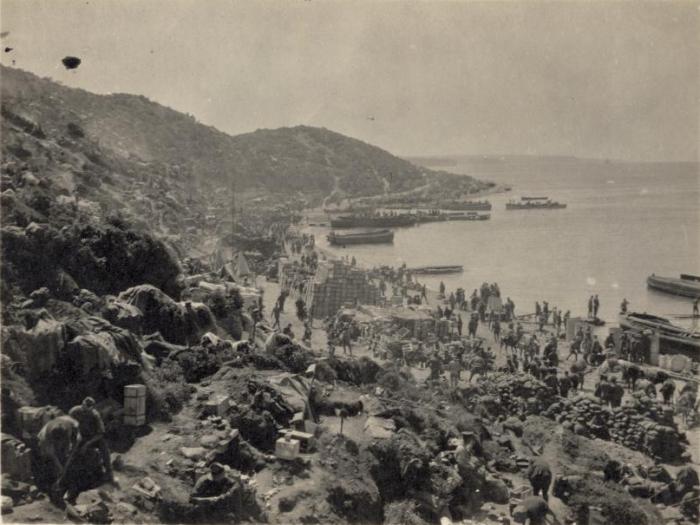
The battleships moved in after them until the water shallowed.
Every eye was fixed on the grim line of hills in front, menacing in the gloom, and the mysteries of which those in the boats were about to solve.
Every eye was fixed on the grim line of hills in the front, menacing in the gloom, and the mysteries of which those in the boats were about to solve.
Not a sound was heard, and when a light was seen it appeared as if the enemy had been surprised. In our nervy state the stars were often mistaken for lights ashore.
When close in at least three boats broke away from their tow and drifted down the coast without control. They were heavily sniped at the whole way, and steadily lost their men.
The work of disembarking proceeded mechanically under point blank fire. The moment the boats touched the beach the troops jumped ashore and doubled for cover, but the gallant boat crews had to pull in and out under the galling fire from hundreds of points.
All through April 25 this went on during the landing of troops, ammunition, and stores. When it was daylight the warships endeavored to support the boats by heavy fire from their secondary armaments, but, not knowing the enemy's position, the support was more moral than real.

ANZAC COVE OR GABA TEPE
When the sun had fully risen we could see that the Australians had actually established themselves had actually established themselves on the ridge, trying to work their way northward along it.
The fighting was so confused, and it occurred on such broken ground, that it was difficult to follow exactly what happened on April 25th, except that the covering forces carried out their task so splendidly that the disembarkation of the remaining was allowed to proceed uninterruptedly, except the never-ceasing sniping.
The progress of the boats was slow, and dawn was rapidly breaking.
At 10 minutes to 4 o'clock the enemy showed an alarm light, which flashed for ten 10 minutes, and then disappeared.
Our boats appeared almost as one on the beach, and seven torpedo-boat destroyers glided noiselessly inshore, and at seven minutes to 4 o'clock came a sharp burst of rifle-fire from the beach. The sound relieved the prolonged suspense, which had become almost intolerable.
When the fire had lasted a few minutes a faint British cheer came over the waters, telling us that the first position had been won.
At 3 minutes minutes past 3 o'clock the fire became intensified. By the sound we could tell our men were firing. This lasted 25 minutes, and then died down somewhat, and the boats returned.
A pinnace as the first to come alongside.
There were two recumbent figures on the deck, and a small midshipman, cheerful, and waving his hand, with a shot through the stomach.
The three men had been wounded in the first burst of musketry.
The Australians rose to the occasion. Not waiting for orders, or for the boats to reach the beach, they sprang into the sea, and, forming a sort of rough line, rushed at the enemy's trenches.
Their magazines were not charged, so they just went with cold steel.
It was over in a minute. The Turks in the first trench were either bayoneted or they ran away, and their Maxim was captured.
Then the Australians found themselves facing an almost perpendicular cliff of loose sandstone, covered with thick shrubbery. half-way up, the enemy had a second trench, strongly held, from which they poured a terrible fire on the troops below and the boats pulling back to the destroyers for the second landing party.
Here was a tough proposition to tackle in the darkness, but those colonials, practical above all else, went about it in a practical way. They stopped for a few minutes to pull themselves together, got rid of their packs, and charged their magazines.
Then this race of athletes proceeded to scale the cliffs without responding to the enemy's fire. They lost some men, but did not worry.
In less than a quarter of an hour the Turks were out of their second position, either bayoneted or fleeing.
There has been no finer feat in this war than this sudden landing in the dark and storming the the heights, above all holding on whilst the reinforcements were landing ...
As the daylight came it was seen that our landing was further north of Gaba Tepe than was intended originally; and at a point where the cliffs rise very sheer. The efforts were a blessing disguise, because there was no glacis, down which the enemy could fire; and the broken ground afforded good cover. once our men passed across the 40 yards of flat beach.
The country in the vicinity of of the landing is formidable and forbidding. Out to see it presents a steep front, broken into innumerable ridges, bluffs, valleys and sand pits...
Rising to a height of several hundred feet, and with a surface of crumbly sandstone, covered with a thick shrubbery of about 6 ft. in height, it is ideal fro snipers; as the Australians soon found to their cost.
On the other hand, the Australians proved themselves adept at this kind of warfare.
In the early part of the day heavy casualties were suffered in the boats conveying the troops from the destroyers and in the tugs from the transports. The enemy's sharpshooters were were hidden everywhere, and they concentrated their fire on these boats.
But then the Australians whose blood was up, instead of entrenching, rushed northwards and eastwards, searching for fresh enemies to bayonet. It was difficult country in which to entrench. Therefore, they preferred to advance.
The Turks only had a weak force actually holding the beach. They relied on the difficult ground and snipers to delay the advance until their reinforcements to to come up.
Some of the Australasians who pushed inland were counter-attacked and almost outflanked by the oncoming reserves. They had to fall back after having suffered heavy losses.
These counter-attacks were continued by the Turks throughout the afternoon, but the Australasians did not yield a foot on the main ridge.
Reinforcements poured up from the beach, but the Turks enfiladed the beach with with two field guns from Gaba Tepe. This shrapnel fire was incessant and deadly, and the warships for some hours vainly tried to silence it.
The majority of the heavy casualties during the day were from the shrapnel which swept the beach and the ridge where the Australians established themselves later in the day. Then the enemy's guns were silenced or or forced to withdraw, and a cruiser, moving close inshore plastered Gabe Tepe with a hail of shell.
Towards dusk the the attacks became more vigorous. The enemy was supported by powerful artillery inland, which the ship's guns were powerless to deal with. The pressure on the Australians became heavier, and their lines had to be contracted.
General Birdwood and his staff landed in the afternoon, and devoted their energies to securing the position so as to hold it firm until the next morning, when it was hoped to get the field guns into position.
Some idea of the difficulty may be gathered when it is remembered that every round of ammunition and all water and stores had to be landed on a narrow beach and carried up pathless hills and valleys several hundred feet high to the firing line.
The whole mass of our troops was concentrated in a very small area, and was unable to reply when exposed to a relentless and incessant shrapnel fire which swept every yard of ground.
Fortunately much of the enemy's fire was badly aimed and heir shells burst too high.
A serious problem was getting to the wounded from the shore. All those unable to hobble had to be carried from the hills on stretchers, and then their wounds hastily dressed and the men carried to the boats.
The boat parties worked unceasingly through the entire day and night.
The courage displayed by these wounded Australians will never be forgotten. Hastily placed in trawlers, lighters, and boats, they were towed to the ships, and in spite of their sufferings, cheered on reaching the ship from which they had set out in the morning.
In fact, I have never seen anything like these wounded Australians in war before.
Though many were shot to bits, without the hope of recovery, their cheers resounded throughout the night. You could see in the midst of the mass of suffering humanity arms waving to the crews of the warships.
They were happy because they had been used for the first time and had not been found wanting.
For fifteen mortal hours our men occupied the height under an incessant shell fire, without the moral or material support of a single gun ashore, and they were the subjected the whole time to the violent counter-attack of a brave enemy, skillfully led, with skilled snipers deliberately picking off every officer who endeavoured to give a command or lead his men.
NOTE: Ashmead Bartlett followed up that report with another dispatch on the second day's fighting. 'Those colonials,' he wrote, 'are extraordinary under fire,' He was amazed to see them bathing in the sea, with shrapnel bursting all around them.
Throughout the night of Monday, April 26, the Turks harassed our lines by creeping up and endeavouring to snipe the Australasian troops in their trenches, which were subjected to constant shell-fire. But the Turks never dared to press their attack, although they were in overwhelming numbers.
The Turks paid dearly for their temerity. One section of the New Zealanders, with a bayonet charge , drove the enemy of in disorder. It was obvious on the morning of Tuesday, April 27, that the Turks had not recovered from the terrible hammering they received on the previous day, and no stomach for another big attack.
Our entrenchments were then firmly established, in a semi-circular front along the whole of the foreshore, which was being used for the disembarkation of the troops, supplies and ammunition. The position of the colonial troops was also measurably improved by the landing of field-guns and of several Indian batteries.
It was evident that the Turks intended on April 26th to drive the Australians into the sea by a great concentration of infantry and by increasing the shrapnel fire.
They expected to find our line thinly held, the men exhausted by their losses and exertions during the landing, and so on. They were disillusioned.
these Australians were determined to die to a man rather than surrender the ground they had so dearly won. Every man knew that his only hope of safety lay in victory, as it was impossible to re-embark the army once the ring of hills commanding the beach had been lost.
Most troops, when under fire for the first time, especially volunteers with only a few months' training, keenly felt losses at the beginning, more especially if these occur before they have had time to settle down, but these colonials were the exception to the rule.
Despite their heavy losses, the survivors were as keen as ever. Throughout Tuesday the enemy resorted to new tactics in the hope of driving the colonials off the shore and so preventing supplies and reinforcements reaching the beach.
The Turks on Tuesday night brought up many field guns, with which they opened a tremendous bombardment of the foreshore and the sea, and kept up an incessant rain of shrapnel on the trenches. They could no longer enfilade the beach, as every attempt to place their guns was immediately checkmated by a few well aimed salvos from the Allied warships.
The Turkish gunners tried to put a great curtain of shrapnel over the sea between the warships and the transports and the shore.
It was an amazing sight . Scores of shells were bursting and churning up the water like a great hailstorm.
Some of the shells fell far out to sea. Others, again, made a great danger zone through which the Allie's boats and trawlers had to pass.
This hail of lead did not make the slightest difference to the gallant crews of the pinnaces, boats, lighters, and tugs. They took as much notice of it as they would of a tropical thunderstorm. The spectacular effect of the bombardment was magnificent, but the damage practically nil.
The Anglo-French warships throughout Tuesday incessantly fired on any of the enemy's infantry which attempted to advance. Our hydroplanes did excellent work in directing the fire on the Turkish guns instead.
The indirect firing of the warships has become more efficient every day. It is now so accurate that nothing in range can live, provided the target is accurately spotted. The Turks frequently fire their heavy guns on the other side of the peninsula, hoping to hole the transports, but they have not yet succeeded.
If a Turkish warship in the Straits makes any attempt to attack, a salvo from the Allies' ships speedily forces her to fly up the channel.
The scene ashore is one of the most intense activity. One lands in an avalanche of shrapnel. and finds regiments waiting on the beach before moving to the trenches. Fatigue parties are unloading boats and lighters, and mule trains are endeavouring to drag field guns into position, while the Indians are engaged in conveying mountain guns to the point where they are needed. At the dressing stations all are busy tending the wounded, and the telegraph and telephone units are laying the wires of communication. meanwhile landing parties from the warships have been busy building bomb-proof shelters.
Thousands of hardy Australians and New Zealanders are concentrated on a narrow shore, each engaged in some occupation, for as soon as a man leaves for the front trenches he is required for fatigue duty. Few have had more than a few hours sleep for days past. The General's staff fare no better than the men...
These colonials are extraordinarily good under fire, often exposing themselves rather than take the trouble to keep under shelter of the cliff. One of the strangest sites was to see the numbers bathing in the sea with the shrapnel bursting all around them.
...............................................
FLAGS OF THE COMBATANTS AT GABA TEPE - ANZAC COVE LANDINGS
AUSTRALIA

.................
NEW ZEALAND

........................
UNITED KINGDOM (UK)

...........
Ottoman Empire

.....................................................
Ellis Ashmead- Bartlett
Ellis Ashmead-Bartlett (11 February 1881 – 4 May 1931) was an English war correspondent during the First World War. Through his reporting of the Battle of Gallipoli, Ashmead-Bartlett was instrumental in the birth of the Anzac legend which still dominates military history in Australia and New Zealand. Through his outspoken criticism of the conduct of the campaign, he was instrumental in bringing about the dismissal of the British commander-in-chief, Sir Ian Hamilton – an event that led to the evacuation of British forces from the Gallipoli peninsula.
Biography

Early years
Born in 1881, Ashmead-Bartlett was the eldest son of Conservative Party MP, Sir Ellis Ashmead-Bartlett. He went to Marlborough College and served as a lieutenant in The Bedfordshire Regiment during the Boer War. In April 1902 he was called to the bar at Inner Temple.[1] Two years later, Ashmead-Bartlett arrived in Manchuria to report the Russo-Japanese War. Soon after the war, he published one of the major books on that conflict: Port Arthur: The Siege and Capitulation (William Blackwood & Sons).
Arrival at Gallipoli
Ashmead-Bartlett's role as a war correspondent reached maturity during World War I. As correspondent for the Fleet Street papers, Ashmead-Bartlett, who worked for The Daily Telegraph, covered 25 April 1915 landing at Anzac Cove. He had gone ashore at Anzac Cove at 9.30 p.m. on the evening of the landing and, wearing a non-regulation green hat, was promptly arrested as a spy but was released when the boatswain who had brought him ashore testified for him.
Ashmead-Bartlett was responsible for the first eyewitness accounts of the battle. His report of the landing was published in Australian newspapers on 8 May, before the reports of the Australian correspondent, C.E.W. Bean. His colourful prose, unrestrained by the pursuit of accuracy which hampered Bean's dispatches, was thick with praise for the Anzacs and went down well with Australian and New Zealand audiences:
:"There has been no finer feat in this war than this sudden landing in the dark and storming the heights, and, above all, holding on while the reinforcements were landing. These raw colonial troops, in these desperate hours, proved worthy to fight side by side with the heroes of Mons, the Aisne, Ypres and Neuve Chapelle."
On 27 May 1915, Ashmead-Bartlett was aboard HMS Majestic, a Royal Navy battleship anchored off W Beach at Cape Helles, when it was torpedoed by the German U-boat U-21. Two days earlier he had seen HMS Triumph go down off Anzac, the first victim of the U-21, and he was well aware that the Majestic would likely suffer the same fate. On the night of 26 May he helped drink the last of the ship's champagne. He had his mattress brought up on deck so that he would not be trapped in his cabin. Ashmead-Bartlett survived the sinking but lost all his kit. He sailed for Malta to acquire a new wardrobe.
Return to London
As the battle progressed, Ashmead-Bartlett's reports became highly critical which left him in disfavour with the British commander-in-chief, General Sir Ian Hamilton. Instead of returning to the Dardanelles from Malta, he went on to London, arriving on 6 June, to report in person on the conduct of the campaign. During his time in London, he met with most of the senior political figures including Bonar Law (the Colonial Secretary), Winston Churchill (by that time displaced as First Lord of the Admiralty), Arthur Balfour (Churchill's replacement at the Admiralty) and the Prime Minister, H. H. Asquith. He was also questioned by the Secretary of State for War, Lord Kitchener.
When he returned to Gallipoli, Ashmead-Bartlett established himself on the island of Imbros which was also the site of Hamilton's headquarters. Here he lived in relative safety and comfort, even having brought his own cook from Paris. Returning to the peninsula, he witnessed the new landing at Suvla during the August Offensive:
"Confusion reigned supreme. No-one seemed to know where the headquarters of the different brigades and divisions were to be found. The troops were hunting for water, the staffs were hunting for their troops, and the Turkish snipers were hunting for their prey."
Ashmead-Bartlett had obtained a movie camera while in London with which he captured the only film footage of the battle. On 21 August he was watching from Chocolate Hill when the British IX Corps launched the final attack of the campaign, the Battle of Scimitar Hill. While filming, he was buried when an artillery shell landed nearby but was quickly dug free.
Criticism of Gallipoli
When Australian journalist Keith Murdoch arrived at Gallipoli in September 1915, Ashmead-Bartlett found a receptive audience for his commentary and analysis of the campaign. Murdoch traveled to London carrying a letter from Ashmead-Bartlett – it is disputed whether Murdoch knew the contents – which damned the campaign, describing the final offensive as "the most ghastly and costly fiasco in our history since the Battle of Bannockburn". The letter, intended for Asquith, was intercepted in Marseilles and on 28 September, Ashmead-Bartlett was told to leave Gallipoli.
On his return to London, Ashmead-Bartlett gave an "interview" to The Sunday Times (an opinion piece presented as an interview to circumvent censorship rules). Published on 17 October, it was the first detailed account of the campaign and was widely circulated, published in The Times and Daily Mail as well as in Australian papers.
After Gallipoli
Short of money, Ashmead-Bartlett undertook a lecture tour of England and Australia. He reported on the fighting on the Western Front in France. Following the war, Ashmead-Bartlett, (an opponent of Communism) fought in Hungary against the Bolsheviks.[2] He spent two years (1924–1926) as a Conservative Member of Parliament for the Hammersmith North constituency in London.
Ashmead-Bartlett later became the Daily Telegraph's India correspondent. His coverage was noted for his strong hostility to Gandhi's campaign for Indian Independence.[3]
He died in Lisbon in 1931 (from illness)

Select works
"Calls to the Bar". The Times (36750). London. 24 April 1902. p. 8.
Balázs Ablonczy, Pál Teleki (1874–1941): The Life of a Controversial Hungarian Politician. Boulder, Colo., Social Science Monographs, 2006 (p. 53). ISBN 9780880335959
Mr. Ellis Ashmead-Bartlett, chief correspondent in India for the Conservative Daily Telegraph...despises the followers of Gandhi, asserts that the campaign of civil disobedience is leading to open rebellion, and urges the British to adopt strong methods at once." "The World Over", The Living Age magazine, December 1930, (p.342)
Carlyon, Les (2001). Gallipoli. Macmillan. ISBN 0-7329-1128-1.
Kowner, Rotem (2006). Historical Dictionary of the Russo-Japanese War. Scarecrow. ISBN 0-8108-4927-5.
Leigh Rayment's Historical List of MPs
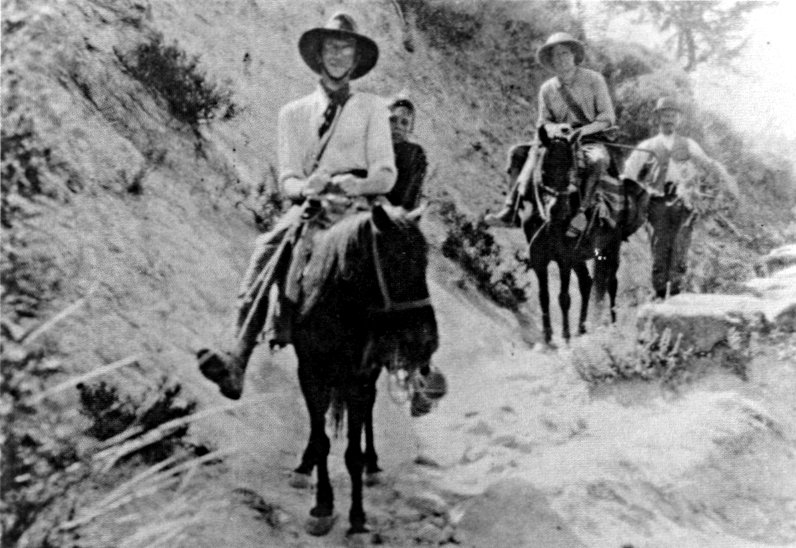
Ashmead-Bartlett is on rear horse
From Wikipedia with thanks
........................
http://arc.parracity.nsw.gov.au/blog/2015/03/25/a-parramatta-mans-account-of-the-gallipoli-landing-by-ernest-edward-herrod/
Ernest Edward Herrod (1885-1966), was born
on 21 June 1885 at Redfern, Sydney. On 29 August 1914 he married
Kathleen Elizabeth Regan, a milliner, from Wentworth Street
Parramatta. Herrod enrolled as a trooper in the local 1 Australian Light
Horse Regiment in 1905 and in August 1914, soon after the declaration
of war, he was one of the first to enlist in the 2nd Battalion,
Australian Imperial Force.
Ernest landed at Gallipoli on 25 April 1915 as the battalion signals officer and was promoted lieutenant that day. He served at Lone Pine, was appointed officer commanding ‘A’ Company in August and was promoted to Captain in September. From May to August he worked as a signaler, an intelligence officer and the battalion’s assistant adjutant. Herrod was evacuated sick from Anzac, suffering from jaundice and colitis, on 8 December and rejoined his unit in Egypt on 6 March 1916. [1]
In a letter dated 10 May 1915, published in the Cumberland Argus and Fruit growers Advocate he wrote of the days leading up to the 25 April landing and the days following.
 The Desperate Landing of the Australians No Sleep for Four Days A Parramatta Fighter’s Vivid Story.
Lieut K. E. Herrod tells a moving story in a letter to his wife, who resides in Wentworth Street, Parramatta. 10/5/’15
Since leaving Mena on the evening of Easter Saturday, things have
happened. Owing to a lull in the fighting and also to the fact that our
ranks have been sadly depleted, I am now acting in addition to signal,
Regimental Censor. Arrived in Cairo, midnight Easter Saturday, and
left by train immediately for Alexandria and embarked on ‘A 10____, ‘ n
captured German N.D.L. liner. Left Alexandria on Easter Monday, and
after a couple of days voyage anchored in Mudros Bay in the Island of
Lemnos. Remained there for nearly three weeks, during which time the
harbor filled with all sorts of warships, transports, and supply ships,
not to mention submarines, a balloon ship, and an aeroplane ship
carrying four aeroplanes. We went ashore twice while there, but merely
to practice disembarking. It is a decidedly pretty and quiet little
island, inhabited by Greeks, and the green hills were a lovely contrast
to the awful sand at Mena. The island seemed covered with quaint old
windmills (used for grinding grain) of one of which I took a snapshot.
We enjoyed our three weeks on the____, it being a very fine boat. We had
two battalions on board, 2nd and 3rd. The officers’ cabins were almost
luxurious, two berths in each (I shared with Pain). The luxury of a
hot bath each day was just glorious after being mobilised for eight
months. Quite a number of the men were wondering (and not a few growling
about it too) whether we would over be given an opportunity to prove
ourselves even after Sir Ian Hamilton telling us at Mena that we would
have all the fight and perhaps more than we were bargaining for; some of
them still wondered as the weeks went by, whether we would ever be
under fire; some of them knew with what fierceness and suddenness it
would come, or I don’t think they would have growled at such long
inaction. The fleet moved out of Mudros Bay on Friday and anchored
behind an island near the Gallipoli Peninsula out of sight of the Turks.
On Sunday, April 25th, it will be IMPOSSIBLE FOR ANY OF US TO FORGET THAT DAY, just before dawn, the whole fleet crept out from the shelter of the island and moved in towards the mainland. With a suddenness that was awful our war commenced. Boom-crash spoke the big guns from the Turkish forts and land batteries, to be immediately answered by our warships (the Queen Elizabeth, dreadnought) built since the outbreak of the war and carrying eight 15 inch and sixteen 6 inch guns, being amongst them.) The Third Brigade landed first, the First and Second following immediately afterwards. The landing, which should have been impossible, was effected and the whole of third infantry brigade were ashore before 9 a.m. Shrapnel poured on us like rain. I will not attempt to describe the horrors of the landing. We left the transports by rope ladders into torpedo, boat destroyers out of range of the guns, came close into shore and then clambered from the destroyers into ships boats and rowed ashore jumping out waist deep and wading ashore under an appalling shrapnel fire. Had we hesitated or even wavered for a second on getting a footing, not one of us would have lived, as it would have been impossible to get back to the ships. All our baggage was left on the transports and as soon as we got ashore we threw off our packs, fixed bayonets and went for them. There was hardly a shot fired from our rifles during the first hour or so, and that in my opinion gave us the position so quickly. The men advanced, clambered up the steep hills carrying everything in front of them by the bayonet. How they did fight! The Australian as a soldier will do me.
The Turks call us ‘THE-BIG WHITE WILD GHURKAS’ and are positively afraid to surrender. The few wounded, the few that have fallen into our ‘hands’ say that thousand’s would have surrendered in the first few days but that they were afraid we would kill them. During the early days of this battle the enemy, so mutilated what wounded fell into their hands, and we had lost so many men that our lads, I am afraid, did not feel disposed to take any risks. Besides that the enemy are using such a lot of German ruses that it is impossible to trust them. We had one instance of a party of stretcher bearers bringing in wounded. Strange to say the body on the stretcher had a blanket thrown over it. It being dusk made it not too easy to distinguish objects for certain, and as this party approached they called out “Don’t shoot, we are bringing in wounded.” When they got nearer they suddenly dropped the stretcher and the body on the stretcher was a machine gun, and the bearers were Turks dressed in our uniforms; fortunately they were shot down before they were able to open fire. They adopt all sorts of ruses and are a cunning as it is possible to imagine. But they can’t fight like our boys, and they wiil not stand up against our bayonets, although they are brave and go to certain death to try to got through our line. [ … Just to note that this was a commonly expressed sentiment in the very early days of the conflict, almost all of which in fact proved to be the result of false rumours. As the conflict wore on the mutual respect for the fairness and respect took its place … Geoff Barker, Research and Collections Services Coordinator, Parramatta City Council Heritage Centre] To return to my narrative — After landing, half our battalion under Major Scobio was sent to the centre, and the other half’- under Colonel Braund to the extreme left flank — the separation was for over for a lot of them. I went with the Colonel to the left. Had extreme difficulty in keeping up communication with headquarters; this was a pure fight for position, maneuvering was of course impossible. The scheme was to capture a ridge running in a semi-circle in order to give us enough ground to form a base and to make the position safe until such time as we could bring our guns, baggage, and transport ashore. Have since found that they gave us a fortnight to do it. Need I say anything to extol this army corps (for the New Zealand division joined us on Monday) when I tell you that we took the position in three days?
I never want to experience another such three days. WE DID NOT CLOSE AN EYE from the time we left the boat until Wednesday. The left flank suffered terribly and after getting the ridge we were beaten back on account of the terrible loss amongst our officers and senior non-com, officers. We regained the position on Tuesday afternoon. The men became hopelessly mixed on the Tuesday. Tuesday night I held a sector of the position with 50 men under me and they were made up of men from about 16 different battalions, about half of them being New Zealanders. You can imagine, after three days fighting and digging without a wink of sleep, and holding a very precarious position with a mixed body of men and only one, non-com officer, whom I knew, what a night it was. We were attacked repeatedly, fortunately by only handfuls of men; but it was pitch dark and impossible to know that till morning. The ground is covered with low, thick scrub and some of the enemy crawled right up to our trench and threw hand grenades at us, which fortunately fell short. We were relieved in the morning by a brigade of New Zealanders and our brigade retired to the beach for four days rest. WHAT AN AWFUL ROLL CALL WE HAD: Killed: Major Gordon, Captain Concannon, Lieutenants Heugh, Solling, Kelly, Dawson. Wounded: Major Scobie, Major Burke, Captains Richardson, Watson, Lieutenants Tarrant, Fourdrinier, Smith, Stewart, Cook, R. T. Brown; 15 out of 30. We mustered 480 out of 1000. The Colonel made a name for himself and proved himself an absolute ‘brick’ under fire. He was shot dead the second day, after moving up after our four days rest. We now find ourselves on Monday, 10/5/ ’15, nearing the end of a very hard fought battle, so strongly entrenched that it would take at least eight times our strength to beat us out. Simultaneously with our landing an army corps of British troops landed further south (on the extreme south of the peninsula of Cape Hellad ) and troops were also landed further north. We know nothing of them. We landed between Capes Sulva and Kaba Tepo. We have had an extremely hard time and the A.I.F. has made a name for itself and Australia (I think — I have no idea of what the newspapers have published). General Birdwood personally visited us while we were resting and thanked and congratulated the Colonel, Captain Stevens, Mr. Harrison, Mr. Pain, and myself. We all understood that we were going to be mentioned in despatches. The worst is now over.
HOW ANY OF US CAME THROUGH is hard to understand. Shrapnel is awful, machine guns are deadly. I have seen men struck, by a machine, gun bullet and before they had time, to fall receive an other half dozen. Solling was shot through the top of the heart, and one of my men tried to carry him back to a doctor, but he died on Stephenson’s back a very few minutes after being hit. I will try to find his grave and get a photo of it, in case Vera would like it. I feel extremely sorry for her, and hope she is bearing up well. As I said before, the worst is over now. We are now entrenched, living under the ground like so many rabbits. When we are in our ‘dug outs’ we can laugh at the shrapnel, for it cannot reach us. Have not had my clothes off since we landed and did not have a wash or shave for four days. We are fairly comfortable now (certainly a bit itchy). Food is plentiful and good, bully (tinned corned) beef, biscuits, cheese, jam, tea, sugar, with an occasional piece of bacon forms a good basis for a fair menu, and Duffy turns out some rather good dishes. But how frightfully dirty everything is. Water is scarce. It is mostly condensed sea water we are using.
ADMIRATION FOR OFFICERS. I hope you received my cable, and that you will receive this letter. The men are all in excellent health, so far, and it is to be hoped they will continue so. I am quite well myself, feeling fit for any job that comes along. Now that we have established ourselves, I am in a good deep dug out, well sheltered from the shrapnel and have the orderly room on one side, and my signal office on the other; am doing all my work by telephone, so most of my men are having an easy time just now, and my work will remain easy till we start to advance; it will then be hard, but I do not think very risky. Colonel Brown, our new C.O., is a very fine fellow. He was Major in the 3rd Battalion, and was slightly wounded on three different occasions during the three days. Captain Wallack, our new second in command, was our adjutant at Kensington, a very fine fellow. Captain Stevens (adjutant) was wounded today and Mr. Harrison is acting adjutant. Mr. Pain has charge of B Company and his Sgt. Major has charge of the Mail Gun section; Wootoen, M. Gun. 1st Battalion, is O.K.; Tinkler, sig., 1st Batt, O.K; Goldring, Sig., 3rd Bat, wounded; Smith, sig., 4th Bat., killed.
A BOY’S DEATH. The Goulburn boy Leeson, whom I had for orderly before Duffy, was killed the first day. My Sergt. Major was left at Mena in hospital with pneumonia. We left all our baggage on the boat and have not yet received it, so my valise is still there and my diary in it. Of course there is no certainty that I will be able to get this away; writing it in case an opportunity occurs, and as we have quietened the Turks for a while, I find myself with a little spare time. Have taken a few interesting photos, but during the three days, although I had the camera in my pocket, I positively did not think of it; we did so much and saw so much during that three days that it would be useless even were it possible to describe it. It would have been impossible to have kept up: as it was one officer went mad and several had to be sent away- — nervous breakdowns. Men here who have served in other wars say that we went through in three days what they had previously experienced during a campaign of from two to three years. Our Quarter Master C. A. Whyte (you remember him, he lives at Granville), served through S. Africa, with the Black Watch. His regiment had the heaviest casualty list for that campaign, 2.5 years, and yet they lost a few less during that time than we did in three days. However, that is all over now and things look bright and cheerful. In a few days the people further south will come up and we will no doubt join forces and push on. Do not expect any letters. The most I can send is a field service card occasionally, but no news in this case is good news. Heaps of love and good wishes to everyone.

...................................................
This is an order of battle listing the Allied and Ottoman forces involved in the Gallipoli Campaign during 1915
.................................................

THE STRUCTURE OF THE ANZAC FORCE (UNDER THE COMMAND OF GENERAL WILLIAM BIRDWOOD) WAS
The Australian 1st Division consisting of:
The 1st Infantry Brigade
The 2nd Infantry Brigade
The 3rd Infantry Brigade
The New Zealand and Australian Division
consisting of the New Zealand Infantry Brigade comprising
The Auckland Battalion
The Wellington Battalion
The Otago Battalion
The Canterbury Battalion
The New Zealand Infantry Brigade comprising;
The Wellington Mounted Rifles Regiment
The Canterbury Mounted Rifles Regiment
The Auckland Mounted Rifles Regiment
The New Zealand (Maori) Pioneer Battalion
The 1st Light Horse Brigade, comprising;
The 1st Light Horse Regiment
The 2nd Light Horse Regiment
The 3rd Light Horse Regiment
The Australian 4th Infantry Brigade, comprising;
The 13th Battalion - New South Wales
The 14th Battalion - Victoria
The 15th Battalion - Queensland & Tasmania
The 15th Battalion - Western Australia & South Australia
During the Gallipoli Campaign the ANZAC Force also included (although most were neither Australian nor New Zealanders
The Indian Mountain Artillery - 7th Brigade
The 29th Indian Brigade
The Ceylon Rifles Planters Group
The Zion Mule Troops
Four Royal Navy Division Battalions
The British 10th Division (Irish)
The British 13th Division (West)
May 8, 1915
By Ellis Ashmead-Bartlett
Battle of Gaba Tepe
Mr. Ashmead-Bartlett, the war correspondent of the Daily Telegraph who was on board a warship with 500 Australians forming part of the covering troops for the landing at Gaba Tepe on the Aegean side of the Gallipoli Peninsula, states:—
"It required splendid skill, organisation, and leadership. The huge armada got under way from Mudros Bay, on the Island of Lemnos, without accident. The warships and transports were divided into five divisions. Never before has an attempt been made to land so large a force in the face of a well-prepared enemy.
At 2 o’clock on April 24 the flagship of the division conveying the Australians and New Zealanders passed down the long line of slowly-moving transports, amid tremendous cheering, and was played out of the bay by the French warship."
"At 4 o’clock the ship’s company and the troops on board assembled to hear the admiral’s proclamation to the combined force. This was followed by the last service before the battle, in which the chaplain uttered a prayer for victory, and besought the Divine blessing for the expedition, all the men standing with uncovered, bowed heads."
Steaming to the rendezvous
"At dark all the lights were put out, and the troops rested for their ordeal at dawn. It was a beautiful calm night, with a bright, half-moon."
"By 1 o’clock in the morning the ships had reached their rendezvous, five miles from the intended landing place. The soldiers were aroused, and served with their last hot meal before landing. The Australians, who were about to go into action for the first time under trying circumstances, were cheerful, quiet, and confident, and there was no sign of nerves or excitement."
Australian Troops on HMS Prince of Wales on way to ANZAC COVE
24 April 1915. AWM A01829
The Australians, who were about to go into action for the first time in trying circumstances, were cheerful, quiet, and confident. There was no sign of nerves nor of excitement.
As the moon waned, the boats were swung out, the Australians received their last instructions, and the men who six months ago had been living peaceful civilian lives had begun to disembark on a strange and unknown shore in a strange land to attack an enemy of a different race.
Each boat, which was in charge of a midshipman, was loaded with a great rapidity in absolute silence, and without a hitch, and the covering force towed ashore by the ships' pinnacles. More of the Australian brigade were carried aboard torpedo-boat destroyers, which were to go close inshore as soon as the covering force had landed.
At 3 o’clock it was quite dark, and a start was made towards the shore with suppressed excitement. Would the enemy be surprised, or be on the alert?
At 4 o’clock, three battleships, line abreast and four cables apart, arrived 2,500 yards from the shore, with their guns manned and their searchlights in readiness.
Very slowly, the boats in tow, like twelve great snakes, moved towards the shore. Each edged towards each other in order to reach the beach four cables apart.
The battleships moved in after them until the water shallowed.
Every eye was fixed on the grim line of hills in front, menacing in the gloom, and the mysteries of which those in the boats were about to solve.
Every eye was fixed on the grim line of hills in the front, menacing in the gloom, and the mysteries of which those in the boats were about to solve.
Not a sound was heard, and when a light was seen it appeared as if the enemy had been surprised. In our nervy state the stars were often mistaken for lights ashore.
When close in at least three boats broke away from their tow and drifted down the coast without control. They were heavily sniped at the whole way, and steadily lost their men.
The work of disembarking proceeded mechanically under point blank fire. The moment the boats touched the beach the troops jumped ashore and doubled for cover, but the gallant boat crews had to pull in and out under the galling fire from hundreds of points.
All through April 25 this went on during the landing of troops, ammunition, and stores. When it was daylight the warships endeavored to support the boats by heavy fire from their secondary armaments, but, not knowing the enemy's position, the support was more moral than real.
ANZAC COVE OR GABA TEPE
When the sun had fully risen we could see that the Australians had actually established themselves had actually established themselves on the ridge, trying to work their way northward along it.
The fighting was so confused, and it occurred on such broken ground, that it was difficult to follow exactly what happened on April 25th, except that the covering forces carried out their task so splendidly that the disembarkation of the remaining was allowed to proceed uninterruptedly, except the never-ceasing sniping.
The progress of the boats was slow, and dawn was rapidly breaking.
At 10 minutes to 4 o'clock the enemy showed an alarm light, which flashed for ten 10 minutes, and then disappeared.
Our boats appeared almost as one on the beach, and seven torpedo-boat destroyers glided noiselessly inshore, and at seven minutes to 4 o'clock came a sharp burst of rifle-fire from the beach. The sound relieved the prolonged suspense, which had become almost intolerable.
When the fire had lasted a few minutes a faint British cheer came over the waters, telling us that the first position had been won.
At 3 minutes minutes past 3 o'clock the fire became intensified. By the sound we could tell our men were firing. This lasted 25 minutes, and then died down somewhat, and the boats returned.
A pinnace as the first to come alongside.
 |
| The Small Boats About to Land at Gallipoli |
There were two recumbent figures on the deck, and a small midshipman, cheerful, and waving his hand, with a shot through the stomach.
The three men had been wounded in the first burst of musketry.
The Australians rose to the occasion. Not waiting for orders, or for the boats to reach the beach, they sprang into the sea, and, forming a sort of rough line, rushed at the enemy's trenches.
Their magazines were not charged, so they just went with cold steel.
It was over in a minute. The Turks in the first trench were either bayoneted or they ran away, and their Maxim was captured.
Then the Australians found themselves facing an almost perpendicular cliff of loose sandstone, covered with thick shrubbery. half-way up, the enemy had a second trench, strongly held, from which they poured a terrible fire on the troops below and the boats pulling back to the destroyers for the second landing party.
Here was a tough proposition to tackle in the darkness, but those colonials, practical above all else, went about it in a practical way. They stopped for a few minutes to pull themselves together, got rid of their packs, and charged their magazines.
Then this race of athletes proceeded to scale the cliffs without responding to the enemy's fire. They lost some men, but did not worry.
In less than a quarter of an hour the Turks were out of their second position, either bayoneted or fleeing.
There has been no finer feat in this war than this sudden landing in the dark and storming the the heights, above all holding on whilst the reinforcements were landing ...
As the daylight came it was seen that our landing was further north of Gaba Tepe than was intended originally; and at a point where the cliffs rise very sheer. The efforts were a blessing disguise, because there was no glacis, down which the enemy could fire; and the broken ground afforded good cover. once our men passed across the 40 yards of flat beach.
The country in the vicinity of of the landing is formidable and forbidding. Out to see it presents a steep front, broken into innumerable ridges, bluffs, valleys and sand pits...
Rising to a height of several hundred feet, and with a surface of crumbly sandstone, covered with a thick shrubbery of about 6 ft. in height, it is ideal fro snipers; as the Australians soon found to their cost.
On the other hand, the Australians proved themselves adept at this kind of warfare.
In the early part of the day heavy casualties were suffered in the boats conveying the troops from the destroyers and in the tugs from the transports. The enemy's sharpshooters were were hidden everywhere, and they concentrated their fire on these boats.
But then the Australians whose blood was up, instead of entrenching, rushed northwards and eastwards, searching for fresh enemies to bayonet. It was difficult country in which to entrench. Therefore, they preferred to advance.
The Turks only had a weak force actually holding the beach. They relied on the difficult ground and snipers to delay the advance until their reinforcements to to come up.
Some of the Australasians who pushed inland were counter-attacked and almost outflanked by the oncoming reserves. They had to fall back after having suffered heavy losses.
These counter-attacks were continued by the Turks throughout the afternoon, but the Australasians did not yield a foot on the main ridge.
Reinforcements poured up from the beach, but the Turks enfiladed the beach with with two field guns from Gaba Tepe. This shrapnel fire was incessant and deadly, and the warships for some hours vainly tried to silence it.
The majority of the heavy casualties during the day were from the shrapnel which swept the beach and the ridge where the Australians established themselves later in the day. Then the enemy's guns were silenced or or forced to withdraw, and a cruiser, moving close inshore plastered Gabe Tepe with a hail of shell.
Towards dusk the the attacks became more vigorous. The enemy was supported by powerful artillery inland, which the ship's guns were powerless to deal with. The pressure on the Australians became heavier, and their lines had to be contracted.
General Birdwood and his staff landed in the afternoon, and devoted their energies to securing the position so as to hold it firm until the next morning, when it was hoped to get the field guns into position.
Some idea of the difficulty may be gathered when it is remembered that every round of ammunition and all water and stores had to be landed on a narrow beach and carried up pathless hills and valleys several hundred feet high to the firing line.
The whole mass of our troops was concentrated in a very small area, and was unable to reply when exposed to a relentless and incessant shrapnel fire which swept every yard of ground.
Fortunately much of the enemy's fire was badly aimed and heir shells burst too high.
A serious problem was getting to the wounded from the shore. All those unable to hobble had to be carried from the hills on stretchers, and then their wounds hastily dressed and the men carried to the boats.
The boat parties worked unceasingly through the entire day and night.
The courage displayed by these wounded Australians will never be forgotten. Hastily placed in trawlers, lighters, and boats, they were towed to the ships, and in spite of their sufferings, cheered on reaching the ship from which they had set out in the morning.
In fact, I have never seen anything like these wounded Australians in war before.
Though many were shot to bits, without the hope of recovery, their cheers resounded throughout the night. You could see in the midst of the mass of suffering humanity arms waving to the crews of the warships.
They were happy because they had been used for the first time and had not been found wanting.
For fifteen mortal hours our men occupied the height under an incessant shell fire, without the moral or material support of a single gun ashore, and they were the subjected the whole time to the violent counter-attack of a brave enemy, skillfully led, with skilled snipers deliberately picking off every officer who endeavoured to give a command or lead his men.
NOTE: Ashmead Bartlett followed up that report with another dispatch on the second day's fighting. 'Those colonials,' he wrote, 'are extraordinary under fire,' He was amazed to see them bathing in the sea, with shrapnel bursting all around them.
Throughout the night of Monday, April 26, the Turks harassed our lines by creeping up and endeavouring to snipe the Australasian troops in their trenches, which were subjected to constant shell-fire. But the Turks never dared to press their attack, although they were in overwhelming numbers.
The Turks paid dearly for their temerity. One section of the New Zealanders, with a bayonet charge , drove the enemy of in disorder. It was obvious on the morning of Tuesday, April 27, that the Turks had not recovered from the terrible hammering they received on the previous day, and no stomach for another big attack.
Our entrenchments were then firmly established, in a semi-circular front along the whole of the foreshore, which was being used for the disembarkation of the troops, supplies and ammunition. The position of the colonial troops was also measurably improved by the landing of field-guns and of several Indian batteries.
It was evident that the Turks intended on April 26th to drive the Australians into the sea by a great concentration of infantry and by increasing the shrapnel fire.
They expected to find our line thinly held, the men exhausted by their losses and exertions during the landing, and so on. They were disillusioned.
these Australians were determined to die to a man rather than surrender the ground they had so dearly won. Every man knew that his only hope of safety lay in victory, as it was impossible to re-embark the army once the ring of hills commanding the beach had been lost.
Most troops, when under fire for the first time, especially volunteers with only a few months' training, keenly felt losses at the beginning, more especially if these occur before they have had time to settle down, but these colonials were the exception to the rule.
Despite their heavy losses, the survivors were as keen as ever. Throughout Tuesday the enemy resorted to new tactics in the hope of driving the colonials off the shore and so preventing supplies and reinforcements reaching the beach.
The Turks on Tuesday night brought up many field guns, with which they opened a tremendous bombardment of the foreshore and the sea, and kept up an incessant rain of shrapnel on the trenches. They could no longer enfilade the beach, as every attempt to place their guns was immediately checkmated by a few well aimed salvos from the Allied warships.
The Turkish gunners tried to put a great curtain of shrapnel over the sea between the warships and the transports and the shore.
It was an amazing sight . Scores of shells were bursting and churning up the water like a great hailstorm.
Some of the shells fell far out to sea. Others, again, made a great danger zone through which the Allie's boats and trawlers had to pass.
This hail of lead did not make the slightest difference to the gallant crews of the pinnaces, boats, lighters, and tugs. They took as much notice of it as they would of a tropical thunderstorm. The spectacular effect of the bombardment was magnificent, but the damage practically nil.
The Anglo-French warships throughout Tuesday incessantly fired on any of the enemy's infantry which attempted to advance. Our hydroplanes did excellent work in directing the fire on the Turkish guns instead.
The indirect firing of the warships has become more efficient every day. It is now so accurate that nothing in range can live, provided the target is accurately spotted. The Turks frequently fire their heavy guns on the other side of the peninsula, hoping to hole the transports, but they have not yet succeeded.
If a Turkish warship in the Straits makes any attempt to attack, a salvo from the Allies' ships speedily forces her to fly up the channel.
The scene ashore is one of the most intense activity. One lands in an avalanche of shrapnel. and finds regiments waiting on the beach before moving to the trenches. Fatigue parties are unloading boats and lighters, and mule trains are endeavouring to drag field guns into position, while the Indians are engaged in conveying mountain guns to the point where they are needed. At the dressing stations all are busy tending the wounded, and the telegraph and telephone units are laying the wires of communication. meanwhile landing parties from the warships have been busy building bomb-proof shelters.
Thousands of hardy Australians and New Zealanders are concentrated on a narrow shore, each engaged in some occupation, for as soon as a man leaves for the front trenches he is required for fatigue duty. Few have had more than a few hours sleep for days past. The General's staff fare no better than the men...
These colonials are extraordinarily good under fire, often exposing themselves rather than take the trouble to keep under shelter of the cliff. One of the strangest sites was to see the numbers bathing in the sea with the shrapnel bursting all around them.
...............................................
FLAGS OF THE COMBATANTS AT GABA TEPE - ANZAC COVE LANDINGS
AUSTRALIA
NEW ZEALAND
........................
UNITED KINGDOM (UK)
...........
Ottoman Empire
.....................................................
Ellis Ashmead- Bartlett
Ellis Ashmead-Bartlett (11 February 1881 – 4 May 1931) was an English war correspondent during the First World War. Through his reporting of the Battle of Gallipoli, Ashmead-Bartlett was instrumental in the birth of the Anzac legend which still dominates military history in Australia and New Zealand. Through his outspoken criticism of the conduct of the campaign, he was instrumental in bringing about the dismissal of the British commander-in-chief, Sir Ian Hamilton – an event that led to the evacuation of British forces from the Gallipoli peninsula.
Biography
Early years
Born in 1881, Ashmead-Bartlett was the eldest son of Conservative Party MP, Sir Ellis Ashmead-Bartlett. He went to Marlborough College and served as a lieutenant in The Bedfordshire Regiment during the Boer War. In April 1902 he was called to the bar at Inner Temple.[1] Two years later, Ashmead-Bartlett arrived in Manchuria to report the Russo-Japanese War. Soon after the war, he published one of the major books on that conflict: Port Arthur: The Siege and Capitulation (William Blackwood & Sons).
Arrival at Gallipoli
Ashmead-Bartlett's role as a war correspondent reached maturity during World War I. As correspondent for the Fleet Street papers, Ashmead-Bartlett, who worked for The Daily Telegraph, covered 25 April 1915 landing at Anzac Cove. He had gone ashore at Anzac Cove at 9.30 p.m. on the evening of the landing and, wearing a non-regulation green hat, was promptly arrested as a spy but was released when the boatswain who had brought him ashore testified for him.
Ashmead-Bartlett was responsible for the first eyewitness accounts of the battle. His report of the landing was published in Australian newspapers on 8 May, before the reports of the Australian correspondent, C.E.W. Bean. His colourful prose, unrestrained by the pursuit of accuracy which hampered Bean's dispatches, was thick with praise for the Anzacs and went down well with Australian and New Zealand audiences:
:"There has been no finer feat in this war than this sudden landing in the dark and storming the heights, and, above all, holding on while the reinforcements were landing. These raw colonial troops, in these desperate hours, proved worthy to fight side by side with the heroes of Mons, the Aisne, Ypres and Neuve Chapelle."
On 27 May 1915, Ashmead-Bartlett was aboard HMS Majestic, a Royal Navy battleship anchored off W Beach at Cape Helles, when it was torpedoed by the German U-boat U-21. Two days earlier he had seen HMS Triumph go down off Anzac, the first victim of the U-21, and he was well aware that the Majestic would likely suffer the same fate. On the night of 26 May he helped drink the last of the ship's champagne. He had his mattress brought up on deck so that he would not be trapped in his cabin. Ashmead-Bartlett survived the sinking but lost all his kit. He sailed for Malta to acquire a new wardrobe.
Return to London
As the battle progressed, Ashmead-Bartlett's reports became highly critical which left him in disfavour with the British commander-in-chief, General Sir Ian Hamilton. Instead of returning to the Dardanelles from Malta, he went on to London, arriving on 6 June, to report in person on the conduct of the campaign. During his time in London, he met with most of the senior political figures including Bonar Law (the Colonial Secretary), Winston Churchill (by that time displaced as First Lord of the Admiralty), Arthur Balfour (Churchill's replacement at the Admiralty) and the Prime Minister, H. H. Asquith. He was also questioned by the Secretary of State for War, Lord Kitchener.
When he returned to Gallipoli, Ashmead-Bartlett established himself on the island of Imbros which was also the site of Hamilton's headquarters. Here he lived in relative safety and comfort, even having brought his own cook from Paris. Returning to the peninsula, he witnessed the new landing at Suvla during the August Offensive:
"Confusion reigned supreme. No-one seemed to know where the headquarters of the different brigades and divisions were to be found. The troops were hunting for water, the staffs were hunting for their troops, and the Turkish snipers were hunting for their prey."
Ashmead-Bartlett had obtained a movie camera while in London with which he captured the only film footage of the battle. On 21 August he was watching from Chocolate Hill when the British IX Corps launched the final attack of the campaign, the Battle of Scimitar Hill. While filming, he was buried when an artillery shell landed nearby but was quickly dug free.
Criticism of Gallipoli
When Australian journalist Keith Murdoch arrived at Gallipoli in September 1915, Ashmead-Bartlett found a receptive audience for his commentary and analysis of the campaign. Murdoch traveled to London carrying a letter from Ashmead-Bartlett – it is disputed whether Murdoch knew the contents – which damned the campaign, describing the final offensive as "the most ghastly and costly fiasco in our history since the Battle of Bannockburn". The letter, intended for Asquith, was intercepted in Marseilles and on 28 September, Ashmead-Bartlett was told to leave Gallipoli.
On his return to London, Ashmead-Bartlett gave an "interview" to The Sunday Times (an opinion piece presented as an interview to circumvent censorship rules). Published on 17 October, it was the first detailed account of the campaign and was widely circulated, published in The Times and Daily Mail as well as in Australian papers.
After Gallipoli
Short of money, Ashmead-Bartlett undertook a lecture tour of England and Australia. He reported on the fighting on the Western Front in France. Following the war, Ashmead-Bartlett, (an opponent of Communism) fought in Hungary against the Bolsheviks.[2] He spent two years (1924–1926) as a Conservative Member of Parliament for the Hammersmith North constituency in London.
Ashmead-Bartlett later became the Daily Telegraph's India correspondent. His coverage was noted for his strong hostility to Gandhi's campaign for Indian Independence.[3]
He died in Lisbon in 1931 (from illness)
Select works
"Calls to the Bar". The Times (36750). London. 24 April 1902. p. 8.
Balázs Ablonczy, Pál Teleki (1874–1941): The Life of a Controversial Hungarian Politician. Boulder, Colo., Social Science Monographs, 2006 (p. 53). ISBN 9780880335959
Mr. Ellis Ashmead-Bartlett, chief correspondent in India for the Conservative Daily Telegraph...despises the followers of Gandhi, asserts that the campaign of civil disobedience is leading to open rebellion, and urges the British to adopt strong methods at once." "The World Over", The Living Age magazine, December 1930, (p.342)
Carlyon, Les (2001). Gallipoli. Macmillan. ISBN 0-7329-1128-1.
Kowner, Rotem (2006). Historical Dictionary of the Russo-Japanese War. Scarecrow. ISBN 0-8108-4927-5.
Leigh Rayment's Historical List of MPs
Ashmead-Bartlett is on rear horse
From Wikipedia with thanks
........................
http://arc.parracity.nsw.gov.au/blog/2015/03/25/a-parramatta-mans-account-of-the-gallipoli-landing-by-ernest-edward-herrod/
Account of the Gallipoli Landing by Ernest Herrod


Ernest landed at Gallipoli on 25 April 1915 as the battalion signals officer and was promoted lieutenant that day. He served at Lone Pine, was appointed officer commanding ‘A’ Company in August and was promoted to Captain in September. From May to August he worked as a signaler, an intelligence officer and the battalion’s assistant adjutant. Herrod was evacuated sick from Anzac, suffering from jaundice and colitis, on 8 December and rejoined his unit in Egypt on 6 March 1916. [1]
In a letter dated 10 May 1915, published in the Cumberland Argus and Fruit growers Advocate he wrote of the days leading up to the 25 April landing and the days following.
Ernest E Herrod (Left). Australian War Memorial E01814
“Just Before Dawn”

Lieut K. E. Herrod tells a moving story in a letter to his wife, who resides in Wentworth Street, Parramatta. 10/5/’15
On Sunday, April 25th, it will be IMPOSSIBLE FOR ANY OF US TO FORGET THAT DAY, just before dawn, the whole fleet crept out from the shelter of the island and moved in towards the mainland. With a suddenness that was awful our war commenced. Boom-crash spoke the big guns from the Turkish forts and land batteries, to be immediately answered by our warships (the Queen Elizabeth, dreadnought) built since the outbreak of the war and carrying eight 15 inch and sixteen 6 inch guns, being amongst them.) The Third Brigade landed first, the First and Second following immediately afterwards. The landing, which should have been impossible, was effected and the whole of third infantry brigade were ashore before 9 a.m. Shrapnel poured on us like rain. I will not attempt to describe the horrors of the landing. We left the transports by rope ladders into torpedo, boat destroyers out of range of the guns, came close into shore and then clambered from the destroyers into ships boats and rowed ashore jumping out waist deep and wading ashore under an appalling shrapnel fire. Had we hesitated or even wavered for a second on getting a footing, not one of us would have lived, as it would have been impossible to get back to the ships. All our baggage was left on the transports and as soon as we got ashore we threw off our packs, fixed bayonets and went for them. There was hardly a shot fired from our rifles during the first hour or so, and that in my opinion gave us the position so quickly. The men advanced, clambered up the steep hills carrying everything in front of them by the bayonet. How they did fight! The Australian as a soldier will do me.
The Turks call us ‘THE-BIG WHITE WILD GHURKAS’ and are positively afraid to surrender. The few wounded, the few that have fallen into our ‘hands’ say that thousand’s would have surrendered in the first few days but that they were afraid we would kill them. During the early days of this battle the enemy, so mutilated what wounded fell into their hands, and we had lost so many men that our lads, I am afraid, did not feel disposed to take any risks. Besides that the enemy are using such a lot of German ruses that it is impossible to trust them. We had one instance of a party of stretcher bearers bringing in wounded. Strange to say the body on the stretcher had a blanket thrown over it. It being dusk made it not too easy to distinguish objects for certain, and as this party approached they called out “Don’t shoot, we are bringing in wounded.” When they got nearer they suddenly dropped the stretcher and the body on the stretcher was a machine gun, and the bearers were Turks dressed in our uniforms; fortunately they were shot down before they were able to open fire. They adopt all sorts of ruses and are a cunning as it is possible to imagine. But they can’t fight like our boys, and they wiil not stand up against our bayonets, although they are brave and go to certain death to try to got through our line. [ … Just to note that this was a commonly expressed sentiment in the very early days of the conflict, almost all of which in fact proved to be the result of false rumours. As the conflict wore on the mutual respect for the fairness and respect took its place … Geoff Barker, Research and Collections Services Coordinator, Parramatta City Council Heritage Centre] To return to my narrative — After landing, half our battalion under Major Scobio was sent to the centre, and the other half’- under Colonel Braund to the extreme left flank — the separation was for over for a lot of them. I went with the Colonel to the left. Had extreme difficulty in keeping up communication with headquarters; this was a pure fight for position, maneuvering was of course impossible. The scheme was to capture a ridge running in a semi-circle in order to give us enough ground to form a base and to make the position safe until such time as we could bring our guns, baggage, and transport ashore. Have since found that they gave us a fortnight to do it. Need I say anything to extol this army corps (for the New Zealand division joined us on Monday) when I tell you that we took the position in three days?
I never want to experience another such three days. WE DID NOT CLOSE AN EYE from the time we left the boat until Wednesday. The left flank suffered terribly and after getting the ridge we were beaten back on account of the terrible loss amongst our officers and senior non-com, officers. We regained the position on Tuesday afternoon. The men became hopelessly mixed on the Tuesday. Tuesday night I held a sector of the position with 50 men under me and they were made up of men from about 16 different battalions, about half of them being New Zealanders. You can imagine, after three days fighting and digging without a wink of sleep, and holding a very precarious position with a mixed body of men and only one, non-com officer, whom I knew, what a night it was. We were attacked repeatedly, fortunately by only handfuls of men; but it was pitch dark and impossible to know that till morning. The ground is covered with low, thick scrub and some of the enemy crawled right up to our trench and threw hand grenades at us, which fortunately fell short. We were relieved in the morning by a brigade of New Zealanders and our brigade retired to the beach for four days rest. WHAT AN AWFUL ROLL CALL WE HAD: Killed: Major Gordon, Captain Concannon, Lieutenants Heugh, Solling, Kelly, Dawson. Wounded: Major Scobie, Major Burke, Captains Richardson, Watson, Lieutenants Tarrant, Fourdrinier, Smith, Stewart, Cook, R. T. Brown; 15 out of 30. We mustered 480 out of 1000. The Colonel made a name for himself and proved himself an absolute ‘brick’ under fire. He was shot dead the second day, after moving up after our four days rest. We now find ourselves on Monday, 10/5/ ’15, nearing the end of a very hard fought battle, so strongly entrenched that it would take at least eight times our strength to beat us out. Simultaneously with our landing an army corps of British troops landed further south (on the extreme south of the peninsula of Cape Hellad ) and troops were also landed further north. We know nothing of them. We landed between Capes Sulva and Kaba Tepo. We have had an extremely hard time and the A.I.F. has made a name for itself and Australia (I think — I have no idea of what the newspapers have published). General Birdwood personally visited us while we were resting and thanked and congratulated the Colonel, Captain Stevens, Mr. Harrison, Mr. Pain, and myself. We all understood that we were going to be mentioned in despatches. The worst is now over.
HOW ANY OF US CAME THROUGH is hard to understand. Shrapnel is awful, machine guns are deadly. I have seen men struck, by a machine, gun bullet and before they had time, to fall receive an other half dozen. Solling was shot through the top of the heart, and one of my men tried to carry him back to a doctor, but he died on Stephenson’s back a very few minutes after being hit. I will try to find his grave and get a photo of it, in case Vera would like it. I feel extremely sorry for her, and hope she is bearing up well. As I said before, the worst is over now. We are now entrenched, living under the ground like so many rabbits. When we are in our ‘dug outs’ we can laugh at the shrapnel, for it cannot reach us. Have not had my clothes off since we landed and did not have a wash or shave for four days. We are fairly comfortable now (certainly a bit itchy). Food is plentiful and good, bully (tinned corned) beef, biscuits, cheese, jam, tea, sugar, with an occasional piece of bacon forms a good basis for a fair menu, and Duffy turns out some rather good dishes. But how frightfully dirty everything is. Water is scarce. It is mostly condensed sea water we are using.
ADMIRATION FOR OFFICERS. I hope you received my cable, and that you will receive this letter. The men are all in excellent health, so far, and it is to be hoped they will continue so. I am quite well myself, feeling fit for any job that comes along. Now that we have established ourselves, I am in a good deep dug out, well sheltered from the shrapnel and have the orderly room on one side, and my signal office on the other; am doing all my work by telephone, so most of my men are having an easy time just now, and my work will remain easy till we start to advance; it will then be hard, but I do not think very risky. Colonel Brown, our new C.O., is a very fine fellow. He was Major in the 3rd Battalion, and was slightly wounded on three different occasions during the three days. Captain Wallack, our new second in command, was our adjutant at Kensington, a very fine fellow. Captain Stevens (adjutant) was wounded today and Mr. Harrison is acting adjutant. Mr. Pain has charge of B Company and his Sgt. Major has charge of the Mail Gun section; Wootoen, M. Gun. 1st Battalion, is O.K.; Tinkler, sig., 1st Batt, O.K; Goldring, Sig., 3rd Bat, wounded; Smith, sig., 4th Bat., killed.
A BOY’S DEATH. The Goulburn boy Leeson, whom I had for orderly before Duffy, was killed the first day. My Sergt. Major was left at Mena in hospital with pneumonia. We left all our baggage on the boat and have not yet received it, so my valise is still there and my diary in it. Of course there is no certainty that I will be able to get this away; writing it in case an opportunity occurs, and as we have quietened the Turks for a while, I find myself with a little spare time. Have taken a few interesting photos, but during the three days, although I had the camera in my pocket, I positively did not think of it; we did so much and saw so much during that three days that it would be useless even were it possible to describe it. It would have been impossible to have kept up: as it was one officer went mad and several had to be sent away- — nervous breakdowns. Men here who have served in other wars say that we went through in three days what they had previously experienced during a campaign of from two to three years. Our Quarter Master C. A. Whyte (you remember him, he lives at Granville), served through S. Africa, with the Black Watch. His regiment had the heaviest casualty list for that campaign, 2.5 years, and yet they lost a few less during that time than we did in three days. However, that is all over now and things look bright and cheerful. In a few days the people further south will come up and we will no doubt join forces and push on. Do not expect any letters. The most I can send is a field service card occasionally, but no news in this case is good news. Heaps of love and good wishes to everyone.

Peter Arfanis, Archivist, Parramatta Council, Heritage Centre, 2015
[1] R. E. Cowley, ‘Herrod, Ernest Edward (1885–1966)’, Australian
Dictionary of Biography, National Centre of Biography, Australian
National University,
http://adb.anu.edu.au/biography/herrod-ernest-edward-6652/text11463,
published first in hardcopy 1983, accessed online 18 March 2015....................................................
Allied Forces-Order of battle for the Gallipoli Campaign
Australian soldiers from the 1st Infantry Brigade at Lone Pine, 6 August 1915
Allied forces
Initial landings, 25 April 1915
 Mediterranean Expeditionary Force (General Sir Ian Hamilton)[1]
- British 29th Division
- Royal Naval Division
- Australian and New Zealand Army Corps (Lieutenant General William Birdwood)
- One aviation squadron: No. 3 Squadron, Royal Naval Air Service (based at Tenedos)[2]
 Oriental Expeditionary Corps (General Albert d'Amade)
- 1st Division
August 1915
- Mediterranean Expeditionary Force (General Sir Ian Hamilton)[3]
- VIII Corps (Lieutenant General Sir Francis Davies)
- British 29th Division
- 42nd (East Lancashire) Division
- 52nd (Lowland) Division
- Royal Naval Division
- IX Corps (Lieutenant General Frederick Stopford)
- Australian and New Zealand Army Corps (Lieutenant General William Birdwood)
- Australian 1st Division
- Australian 2nd Division
- New Zealand and Australian Division
- New Zealand Infantry Brigade
- 4th Australian Brigade
- New Zealand Mounted Rifles Brigade
- 1st Australian Light Horse Brigade
- Attached:
- One aviation wing: No. 3 Wing, Royal Naval Air Service (at Imbros)[4]
- Oriental Expeditionary Corps (General Maurice Bailloud)
- 1st Division
- 2nd Division
- One aviation squadron: Escadrille MF98T (based at Tenedos)[4]
- VIII Corps (Lieutenant General Sir Francis Davies)
.................................................

THE STRUCTURE OF THE ANZAC FORCE (UNDER THE COMMAND OF GENERAL WILLIAM BIRDWOOD) WAS
The Australian 1st Division consisting of:
The 1st Infantry Brigade
The 2nd Infantry Brigade
The 3rd Infantry Brigade
The New Zealand and Australian Division
consisting of the New Zealand Infantry Brigade comprising
The Auckland Battalion
The Wellington Battalion
The Otago Battalion
The Canterbury Battalion
The New Zealand Infantry Brigade comprising;
The Wellington Mounted Rifles Regiment
The Canterbury Mounted Rifles Regiment
The Auckland Mounted Rifles Regiment
The New Zealand (Maori) Pioneer Battalion
The 1st Light Horse Brigade, comprising;
The 1st Light Horse Regiment
The 2nd Light Horse Regiment
The 3rd Light Horse Regiment
The Australian 4th Infantry Brigade, comprising;
The 13th Battalion - New South Wales
The 14th Battalion - Victoria
The 15th Battalion - Queensland & Tasmania
The 15th Battalion - Western Australia & South Australia
During the Gallipoli Campaign the ANZAC Force also included (although most were neither Australian nor New Zealanders
The Indian Mountain Artillery - 7th Brigade
The 29th Indian Brigade
The Ceylon Rifles Planters Group
The Zion Mule Troops
Four Royal Navy Division Battalions
The British 10th Division (Irish)
The British 13th Division (West)
Comments
Post a Comment